

How To Import New Tool Into Arcgis Register Dll
- ArcGIS Add-In Installation Utility
- Sharing add together-ins on a network
- Determining add together-in customizations
- Uninstalling the add-in
The .esriaddin file is the key to sharing a Python add-in; all that other users demand to do to execute the add-in is install the .esriaddin file on their automobile or reference it using a network share.
Desktop add-ins are loaded past ArcGIS Desktop applications when the add-in file is discovered in i of several well-known add-in folders. Add-in files can be copied straight to i of these folders or to the appropriate folder automatically using ESRI ArcGIS Add-In Installation Utility.
ArcGIS Add together-In Installation Utility
ESRI ArcGIS Add-In Installation Utility opens when an .esriaddin file is double-clicked. This utility is operational in Windows Explorer, through popular eastward-post applications such as Outlook, and on web pages running on servers that have been configured to deploy add-in files (such as ArcGIS Online).
When ESRI ArcGIS Add-In Installation Utility is invoked, it analyzes the metadata of the selected add together-in file and displays the writer'south name, a clarification of the add-in, and whether the add together-in contains a trusted digital signature. Meet the following analogy:
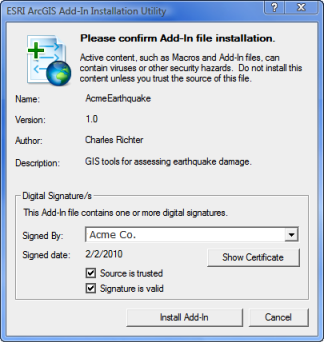
This information can exist used to decide whether to install the add-in. If the user elects to install the add-in, the utility copies the add-in to the user'south default add-in binder.
Add-ins are not backward compatible. Add-ins targeting 10.1, for example, volition not work with 10.0 simply volition work with 10.2.
The installation utility copies the add-in file to a generated subfolder nether the well-known add-in folder; the subfolder is automatically generated based on the globally unique identifier (GUID) specified in the add-in file metadata. This subfolder prevents file naming conflicts that might otherwise occur if several add-ins take the same file name.
Although add-ins can be manually copied to a default add-in folder, doing and then bypasses the security and proper noun conflict checks the add-in installation utility performs. For this reason, apply the installation utility to install an add-in in ArcGIS Desktop applications.
Sharing add-ins on a network
Add-ins tin also be distributed within a individual network using a trusted network share. Add-in files can be copied to these locations and automatically picked up past clients who've added the network share to their add-in folder listing. Additional add-in folders are added using Add-In Director, equally illustrated below.
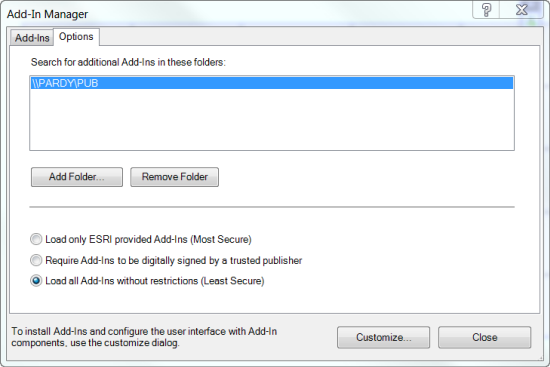
In this scenario, multiple users can benefit from add-ins managed in a primal location. If an add-in needs an update, the newer version can be copied over the existing version (fifty-fifty if in use). Clients automatically get the updated version of the add-in the adjacent time they restart the corresponding desktop application.
Determining add-in customizations
Once an add-in has been installed, Add-In Managing director—accessed from the Customize menu—makes it piece of cake to determine the customizations it contains. The following analogy shows an add-in with a toolbar and a tool:

Uninstalling the add-in
You can uninstall the add-in merely past deleting the .esriaddin file from the add-in folder. Alternatively, you tin utilise the Delete this Add-In on Add-In Director dialog to uninstall the add-in.

Source: https://desktop.arcgis.com/en/arcmap/latest/analyze/python-addins/sharing-and-installing-add-ins.htm
Posted by: howardmith1961.blogspot.com
0 Response to "How To Import New Tool Into Arcgis Register Dll"
Post a Comment